---
title: Price Sensitivity Is Not Binary
description: Learn how price sensitivity varies by context, timing, and intent. A practical guide for Shopify merchants to segment customers by willingness to pay without over-discounting.
image: https://sparklingtools.com/hubfs/Not_Binary.webp
---
[](https://sparklingtools.com/?hsLang=en)
- [Home](https://sparklingtools.com?hsLang=en)
- [Pasaro](https://sparklingtools.com/pasaro-user-guide?hsLang=en)
- [Blog](https://sparklingtools.com/blog)
- [English](https://sparklingtools.com/blog/price-sensitivity-is-not-binary)
- [Español](https://sparklingtools.com/es/blog/price-sensitivity-is-not-binary)
English
[Contact Us](https://sparklingtools.com/contact?hsLang=en)
[](https://sparklingtools.com/?hsLang=en)
close
# Sparkling-Blog
- [Home](https://sparklingtools.com/blog/home?hsLang=en)
- [Blog](https://sparklingtools.com/blog)
e-commerce
## Price Sensitivity Is Not Binary
- January 24 2026
- Sparkling Author
## How to Segment Customers by Willingness to Pay
In e-commerce, price sensitivity is often treated as a binary trait. Customers are labeled as either “price-sensitive” or “not price-sensitive,” and pricing strategies follow accordingly: discounts for the former, premium positioning for the latter.
This simplification is convenient, but inaccurate.
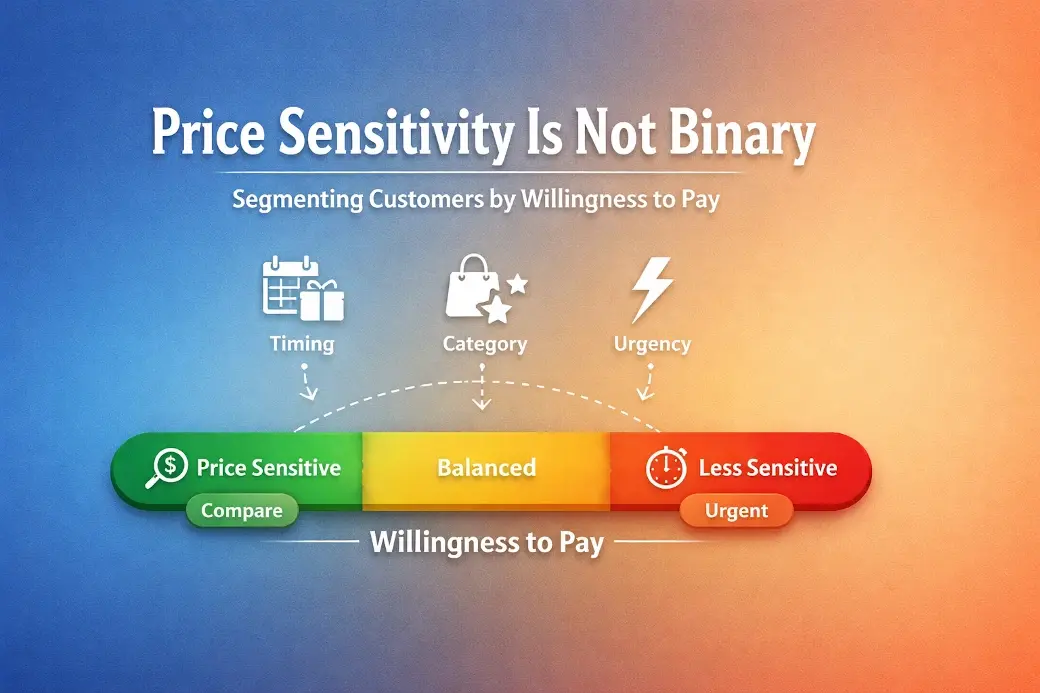
In reality, **price sensitivity is contextual, situational, and dynamic**. The same customer may aggressively compare prices in one moment and pay a premium without hesitation in another. Merchants who understand this nuance move beyond blunt discounting and toward smarter, trust-preserving pricing strategies.
This article explores how to think about price sensitivity as a spectrum, how to identify signals you already have, and how to translate them into practical customer segments, especially in a Shopify environment.
---
## Why Price Sensitivity Is a Spectrum, Not a Switch
Price sensitivity reflects **willingness to pay in a given context**, not a permanent customer attribute. Several factors influence it simultaneously:
- **Urgency** (Do I need this now or later?)
- **Category relevance** (Is this a core product or a discretionary add-on?)
- **Perceived risk** (Is this a known brand or an unfamiliar one?)
- **Emotional state** (Replacing something broken vs. browsing)
- **Reference price** (What do I believe this “should” cost?)
Treating price sensitivity as fixed leads to predictable outcomes:
- Over-discounting customers who would have paid full price
- Training loyal customers to wait for promotions
- Eroding margin without increasing long-term value
A more mature approach starts by acknowledging variability.
---
## Contextual Price Sensitivity: The Missing Layer
The same customer can display radically different price behaviors depending on context. Three dimensions matter most.
### 1. Timing and Urgency
Urgency compresses price sensitivity.
- A customer replacing a broken essential item (charger, shoes, spare part) is far less price-sensitive.
- The same customer browsing the same category weeks later may be highly price-aware.
Signals of urgency often appear as:
- Direct landings on product pages
- Search terms containing “replacement,” “fast,” or specific model numbers
- Short sessions with quick add-to-cart behavior
### 2. Product Category and Role
Customers mentally classify products:
- **Essentials:** reliability > price
- **Upgrades:** value comparison dominates
- **Impulse items:** emotion overrules logic
- **Gifts:** social perception outweighs cost
Price sensitivity varies dramatically across these categories, even for the same individual.
### 3. Moment in the Journey
Early-stage visitors compare.
Late-stage visitors decide.
A merchant who applies uniform pricing pressure across all stages ignores how willingness to pay evolves during the journey.
---
## Signals Merchants Already Have (But Often Ignore)
Most Shopify merchants already collect enough behavioral data to infer relative price sensitivity, without invasive tracking or guesswork.
### Behavioral Signals
- **Repeated product views** without cart addition
- **Sorting by price (low to high)**
- **Coupon code field focus** at checkout
- **Cart abandonment after shipping or taxes**
- **Return frequency correlated with discounts**
### Navigational Signals
- Entry from:
- Price comparison engines
- Branded vs. generic search
- Internal search terms containing price qualifiers (“cheap,” “best price”)
### Transactional History
- Full-price vs. discounted purchase ratio
- Reaction to promotions (conversion uplift vs. margin loss)
- Time-to-purchase after first visit
Individually, these signals are weak. **In combination, they are powerful indicators of situational price sensitivity.**
---
## Practical Segmentation by Willingness to Pay
Segmentation does not require complex machine learning models to be effective. Clear, interpretable segments often outperform opaque ones.
Below are examples merchants can adapt immediately.
### Segment 1: Urgent Buyers (Low Price Sensitivity)
**Typical signals**
- Direct product page entry
- Fast checkout completion
- Low session count before purchase
**Pricing implication**
- Emphasize availability, speed, and reliability
- Avoid unnecessary discounts
- Reinforce trust signals (delivery dates, guarantees)
**Risk to avoid**
- Accidentally discounting through blanket promotions
### Segment 2: Deliberate Comparers (High Contextual Sensitivity)
**Typical signals**
- Multiple sessions
- Category browsing
- Price sorting
- Delayed purchase
**Pricing implication**
- Highlight value, differentiation, and total cost (not just price)
- Use structured comparisons rather than aggressive discounts
- Consider time-based incentives, not permanent price cuts
### Segment 3: Promotion-Reactive Customers
**Typical signals**
- Purchase only during sales
- High coupon usage
- Low engagement outside promotions
**Pricing implication**
- Treat promotions as controlled levers, not defaults
- Limit exposure to constant discounts
- Focus on clearing inventory, not driving core revenue
### Segment 4: Trust-Driven Loyalists
**Typical signals**
- Repeat purchases
- Low price comparison behavior
- Engagement with content and brand pages
**Pricing implication**
- Stability over discounts
- Reward with service, access, or convenience—not price erosion
- Protect long-term margin and brand perception
---
## Why This Approach Builds Trust (Not Just Revenue)
Merchants often worry that differentiated pricing strategies feel manipulative. In practice, the opposite is true when executed responsibly.
A nuanced view of price sensitivity:
- Reduces unnecessary discounting
- Preserves perceived value
- Aligns pricing with customer intent
- Avoids conditioning customers to wait for sales
Most importantly, it reflects **pricing maturity,** a signal customers subconsciously associate with trustworthy, well-run businesses.
---
## Capturing Willingness to Pay Without Forcing a Decision
Understanding price sensitivity is only useful if merchants can act on it without distorting the customer experience. Many shoppers are interested, but not ready—waiting for a price change, a payday, or simply more certainty. Pushing them to convert prematurely often increases resistance rather than revenue.
A more effective approach is to let customers signal intent in their own time. Features like price alerts or availability reminders allow visitors to step away without abandoning the relationship. Instead of forcing a discount or collecting emails aggressively, the store remains present until the context changes.
Pasaro is built around this principle. It enables merchants to capture real buying intent—based on interest and price expectations—while giving customers full control over when they return. The result is fewer forced conversions, more qualified return visits, and a pricing strategy that respects both margin and trust.
Learn how this intent-first approach works with [Pasaro.](https://sparklingtools.com/pasaro-user-guide?hsLang=en)
---
## Final Thought: Smarter Pricing Is Quieter Pricing
The most effective pricing strategies are rarely the loudest. They do not rely on constant urgency, flashing discounts, or artificial pressure.
Instead, they respect context.
Understanding that price sensitivity is not binary—but situational—allows merchants to move from reactive discounting to deliberate segmentation. The result is healthier margins, more predictable growth, and a brand that feels confident rather than desperate.
In modern e-commerce, that confidence is often the strongest conversion signal of all.
---
## Frequently Asked Questions:
### What is price sensitivity in e-commerce?
Price sensitivity in e-commerce refers to how a customer’s likelihood to purchase changes in response to price variations. It is not a fixed customer trait; instead, it varies depending on context such as timing, urgency, product category, and perceived value.
### Is price sensitivity the same for all customers?
No. Even the same customer can display different levels of price sensitivity across situations. For example, a customer may be highly price-conscious when browsing optional products but much less sensitive when urgently replacing an essential item.
### How does contextual price sensitivity affect pricing strategy?
Contextual price sensitivity means pricing decisions should account for customer intent and situation, not just averages. Merchants who consider context can reduce unnecessary discounting while still meeting customer expectations at key decision points.
### What signals indicate a customer’s willingness to pay?
Common signals include browsing behavior, session frequency, product page views, use of price sorting, coupon usage, time to purchase, and prior purchasing patterns. Individually these signals are weak, but together they can indicate relative willingness to pay.
### Can Shopify merchants segment customers by price sensitivity?
Yes. Shopify merchants can create practical segments using existing behavioral and transactional data, such as urgency-driven buyers, comparison-oriented shoppers, promotion-reactive customers, and trust-driven repeat buyers.
### Does segmenting by price sensitivity require advanced machine learning?
No. While advanced models can help at scale, many effective price sensitivity segments can be built using simple rules based on observable behavior, making them transparent and easier to manage.
### How does this approach impact customer trust?
When done responsibly, contextual pricing reduces blanket discounts and aligns offers with genuine customer needs. This avoids conditioning customers to expect constant promotions and supports a more stable, trustworthy brand perception.
### Is segment-based pricing the same as price discrimination?
Not necessarily. Ethical segmentation focuses on relevance and context rather than exploiting individuals. The goal is to match pricing communication and incentives to customer intent, not to obscure or manipulate prices.
### Why is understanding price sensitivity important for long-term growth?
Understanding price sensitivity helps merchants protect margins, reduce dependency on discounts, and build predictable revenue. Over time, this supports healthier customer relationships and more sustainable business growth.
###### Tags:
[e-commerce](https://sparklingtools.com/blog/tag/e-commerce) [sales](https://sparklingtools.com/blog/tag/sales)
###### Share on:
### Leave Your Comment Here
### About us
Sparklingtools LLC is a pioneering Shopify app development company poised to revolutionize online businesses with cutting-edge solutions. With a commitment to excellence, we aim to enhance the e-commerce experience and empower entrepreneurs for success. Stay tuned for our forthcoming game-changing apps.
### Sections
- [Home](https://sparklingtools.com)
- [Pasaro](https://sparklingtools.com/pasaro-user-guide)
- [Blog](https://sparklingtools.com/blog)
### Contacts
- hello@sparklingtools.com
- 500 4th St NW STE 102 Pmb 2495
Albuquerque, New Mexico, US


(c) 2024 All Rights Reserved.
- Terms of Service
- Privacy Policy
```json
{
"@context" : "https://schema.org",
"@type" : "BlogPosting",
"author" : {
"@type" : "Person",
"name" : "Sparkling Author",
"url" : "https://sparklingtools.com/blog/author/sparkling-author"
},
"dateModified" : "2026-01-24T17:07:17.151Z",
"datePublished" : "2026-01-24T17:06:14.000Z",
"headline" : "Price Sensitivity Is Not Binary",
"image" : [ "https://sparklingtools.com/hubfs/Not_Binary.webp" ],
"mainEntityOfPage" : {
"@id" : "https://sparklingtools.com/blog/price-sensitivity-is-not-binary",
"@type" : "WebPage"
},
"publisher" : {
"@type" : "Organization",
"logo" : {
"@type" : "ImageObject"
}
}
}
```
```json
{
"@context" : "https://schema.org",
"@type" : "FAQPage",
"mainEntity" : [ {
"@type" : "Question",
"acceptedAnswer" : {
"@type" : "Answer",
"text" : "Price sensitivity in e-commerce refers to how a customer’s likelihood to purchase changes in response to price variations. It is context-dependent and influenced by factors such as urgency, timing, product category, and perceived value."
},
"name" : "What is price sensitivity in e-commerce?"
}, {
"@type" : "Question",
"acceptedAnswer" : {
"@type" : "Answer",
"text" : "No. Price sensitivity varies not only between customers but also for the same customer across different situations. Context plays a significant role in determining willingness to pay."
},
"name" : "Is price sensitivity the same for all customers?"
}, {
"@type" : "Question",
"acceptedAnswer" : {
"@type" : "Answer",
"text" : "Contextual price sensitivity allows merchants to adapt pricing and incentives based on customer intent and situation, reducing unnecessary discounting while preserving perceived value."
},
"name" : "How does contextual price sensitivity affect pricing strategy?"
}, {
"@type" : "Question",
"acceptedAnswer" : {
"@type" : "Answer",
"text" : "Signals include browsing patterns, session frequency, price sorting behavior, coupon usage, cart abandonment timing, and historical purchasing behavior. Combined, these indicators help infer relative willingness to pay."
},
"name" : "What signals indicate a customer’s willingness to pay?"
}, {
"@type" : "Question",
"acceptedAnswer" : {
"@type" : "Answer",
"text" : "Yes. Shopify merchants can create practical price sensitivity segments using existing behavioral and transactional data, such as urgency-driven buyers, comparison-oriented shoppers, and repeat customers."
},
"name" : "Can Shopify merchants segment customers by price sensitivity?"
}, {
"@type" : "Question",
"acceptedAnswer" : {
"@type" : "Answer",
"text" : "No. Many effective segmentation strategies rely on simple, interpretable rules derived from observable customer behavior rather than complex machine learning models."
},
"name" : "Does segmenting by price sensitivity require advanced machine learning?"
}, {
"@type" : "Question",
"acceptedAnswer" : {
"@type" : "Answer",
"text" : "Responsible segmentation aligns pricing with customer intent and reduces overuse of discounts, supporting clearer value communication and stronger long-term trust."
},
"name" : "How does this approach impact customer trust?"
}, {
"@type" : "Question",
"acceptedAnswer" : {
"@type" : "Answer",
"text" : "No. Ethical segmentation focuses on relevance and context rather than exploiting individuals. The objective is to match pricing communication to customer needs, not to obscure or manipulate prices."
},
"name" : "Is segment-based pricing the same as price discrimination?"
}, {
"@type" : "Question",
"acceptedAnswer" : {
"@type" : "Answer",
"text" : "Understanding price sensitivity helps merchants protect margins, reduce reliance on discounts, and build more predictable revenue, supporting sustainable growth over time."
},
"name" : "Why is understanding price sensitivity important for long-term growth?"
} ]
}
```